05
May
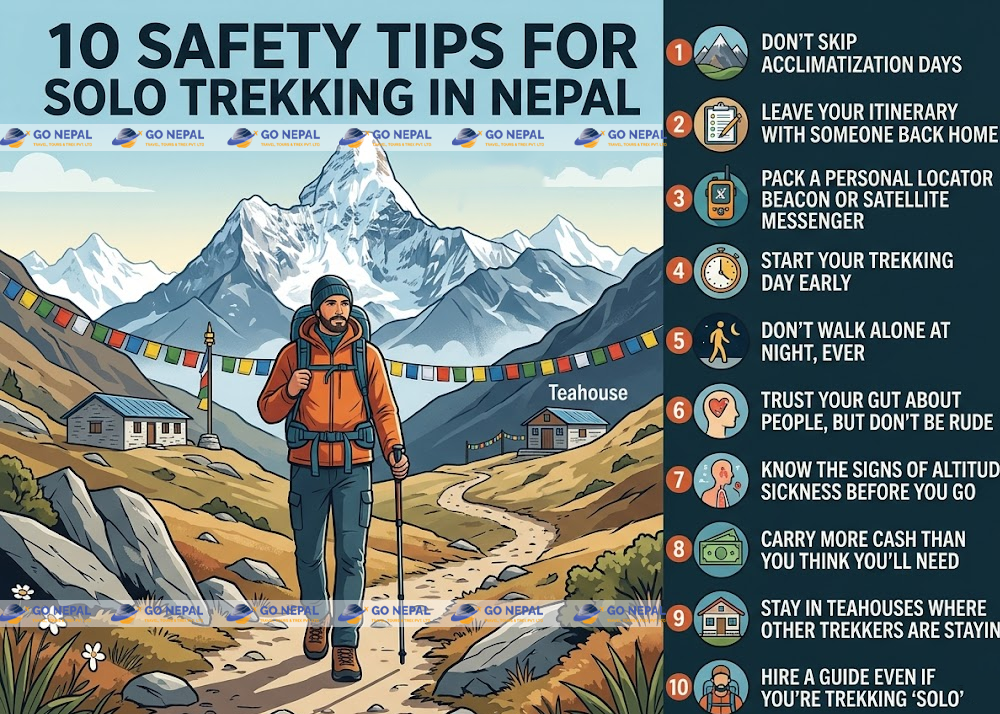
10 Safety Tips for Solo Trekking in Nepal
10 Safety Tips for Solo Trekking in Nepal
Solo trekking in Nepal sounds incredible, doesn’t it? Just you, the mountains, and a trail that’s been walked by adventurers for decades. But here’s the thing most blogs won’t tell you: trekking alone in the Himalayas is not the same as a solo hike in your local national park. The altitude, the remoteness, and the unpredictable weather change everything.
I’ve put together these 10 safety tips based on real experiences from trekkers who’ve done it and guides who’ve seen it all. These are things you actually need to know before you go.
1. Don’t Skip the Acclimatization Days, Even If You Feel Fine
This is the number one mistake solo trekkers make. You’re walking alone, feeling great, so you push ahead faster than the recommended pace. Big mistake. Altitude sickness doesn’t care how fit you are. I’ve seen marathon runners go down with HAPE while a 60-year-old grandma from Switzerland cruised past them.
Here’s what works: plan at least two acclimatization days on any trek above 4,000 meters. On the Everest Base Camp trek, that means a full day in Namche Bazaar and another in Dingboche. Walk slow. Drink more water than you think you need. And if you get a headache that doesn’t go away with rest, go down. Not tomorrow. Now.
2. Always Leave Your Itinerary With Someone Back Home
Sounds obvious, right? But you’d be surprised how many solo trekkers just vanish into the mountains without telling anyone their exact plan. Don’t be that person.
Before you leave Kathmandu or Pokhara, send a copy of your daily itinerary to a friend or family member. Include which teahouse you plan to stay at each night. Then, when you have signal (which happens more often than you’d think on most routes), check in briefly. A simple “made it to Namche” message can save a lot of panic back home.
Pro tip: register at the TIMS desk and any local police check posts along the way. It takes five minutes and adds an extra layer of safety.
3. Pack a Personal Locator Beacon or Satellite Messenger
Look, I know these devices are expensive. But when you’re trekking alone in Nepal, a PLB or a Garmin in Reach is your best friend. Cell phone coverage exists in villages like Namche, Manang, and Jomsom, but there are long stretches where you’ll have nothing.
The satellite messenger lets you send text messages, share your location, and call for help if things go wrong. You can rent them in Kathmandu or Thamel for a reasonable price if buying isn’t an option. I personally wouldn’t trek solo above 4,000 meters without one. It’s not paranoia. It’s just smart.
4. Start Your Trekking Day Early
Here’s a pattern you’ll notice if you spend time on Nepal’s trails: the smart trekkers leave by 6 or 7 AM. The inexperienced ones start at 9 AM and wonder why afternoon clouds roll in, winds pick up, and they’re still walking at sunset.
Afternoons in the Himalayas bring unpredictable weather, especially in spring and autumn. Starting early gives you a buffer. If you twist your ankle at 11 AM, you have daylight to deal with it. If you start late and run into trouble at 3 PM, suddenly you’re looking at a cold, dark night on the trail. Not fun.
Plus, morning light on the mountains is unbeatable. That’s a nice bonus.
5. Don’t Walk Alone at Night, Ever
This should be obvious, but let me say it anyway: no night trekking when you’re alone. Even if you have a headlamp. Even if the trail looks easy on the map. Even if your teahouse is only one more kilometer away.
Trails in Nepal can be narrow, rocky, and slippery. A simple misstep in daylight is annoying. That same misstep at night could mean a broken leg, hours from help, and no one around to hear you call out. Stop before dark. Spend the night where you are. The trail will still be there tomorrow.
6. Trust Your Gut About People, But Don’t Be Rude
You’re going to meet amazing people on the trail. Fellow trekkers, teahouse owners, guides, porters. Most of them are incredibly kind and helpful. But you’re also traveling alone in a foreign country, so keep your wits about you.
If another trekker offers to share their room and something feels off, politely decline. If a stranger insists on walking with you and you’d rather be alone, say you’re planning to go very slow or stop early. You don’t owe anyone access to your time or space. At the same time, Nepali people are generally warm and trustworthy. Don’t walk around suspicious of everyone. Just stay aware.
A good rule of thumb: share meals, share stories, share trail tips. Don’t share your exact room number or detailed plans for the next week with someone you just met.
7. Know the Signs of Altitude Sickness Before You Go
Here’s where a lot of solo trekkers get into trouble. When you’re in a group, other people notice if you’re acting strange or stumbling. When you’re alone, nobody’s watching. So you have to watch yourself.
Learn the difference between mild AMS (headache, nausea, fatigue) and the bad stuff like HAPE (fluid in lungs, gurgling breathing, extreme weakness) or HACE (confusion, loss of coordination, coma). Memorize the symptoms. Better yet, write them on a card and keep it in your pocket.
And remember the only real cure for serious altitude sickness: descend immediately. Don’t wait to see if you feel better after another hour of rest. That hour could cost you.
8. Carry More Cash Than You Think You’ll Need
This one’s practical but crucial. On popular treks like Annapurna and Everest, there are ATMs in some villages. But they run out of cash. Frequently. And when they do, you’re stuck unless you have your own money.
Solo trekkers have no one to borrow from. Carry Nepali rupees enough for at least twice your expected daily budget. A safe estimate is 3,000 to 5,000 rupees per day for food, lodging, and hot showers. For a two-week trek, that’s 50,000 to 70,000 rupees in cash. It feels like a lot, but it’s better than running out in the middle of nowhere.
Keep your cash split between your main bag and a money belt. And bring small bills if you can. Teahouse owners don’t always have change for large notes.
9. Stay in Teahouses Where Other Trekkers Are Staying
Solo doesn’t have to mean isolated. In fact, you want the opposite when it comes to choosing where to sleep. Pick teahouses that already have a few other trekkers staying there. Not crowded necessarily just not empty.
Why? If something happens at 2 AM you get sick, there’s a fire, a freak snowstorm hits having other people around is a huge safety net. Also, those other trekkers become your informal trail community. You start seeing the same faces each night. You look out for each other.
Avoid staying in a completely empty lodge just to save a few hundred rupees. It’s not worth it.
10. Hire a Guide Even If You’re Trekking “Solo”
I know this sounds contradictory. But hear me out. Many solo trekkers in Nepal actually hire a local guide. You’re still traveling alone in the sense that you have no group. But the guide is there for safety, logistics, and local knowledge.
A good guide does more than point the way. They monitor your health for altitude symptoms. They know which teahouses are clean and honest. They handle permits and paperwork. And critically, if something goes wrong, they speak Nepali and know exactly who to call for rescue.
If you absolutely must trek truly alone (no guide, no porter), then stick to the most popular, well-marked trails like Annapurna Circuit or Everest Base Camp during peak seasons. Save the remote treks like Manaslu, Kanchenjunga, or Upper Mustang for when you have local support.
Pros
· You wake up, eat, walk, and stop whenever you feel like it no compromises with anyone.
· Strangers actually talk to you on the trail, so you end up making more friends than people in groups.
· Nepal is cheap enough that even paying for a room alone won’t break your bank.
· You learn to handle your own problems, which sounds scary but somehow feels great afterward.
· The popular trekking routes are so busy that you’re never really alone even when you’re solo.
· No group drama, no waiting for slow packers, and no arguments about where to sleep.
Cons
· You pay full price for things like guides, porters, and private jeeps that groups split five ways.
· Loneliness hits you out of nowhere some evenings, especially in a quiet teahouse at high altitude.
· If you get sick or injured, there’s no friend to notice something’s wrong or go get help.
· Making every single decision for weeks straight gets mentally tiring by day ten or twelve.
· Small mistakes like losing your water bottle or forgetting to charge your headlamp become a bigger deal when you’re alone.
· Asking strangers to take your photo in front of Everest gets awkward after the tenth time.
A Few Quick Takeaways Before You Go
Look, I'm not trying to scare you. Solo travel in Nepal is amazing. Thousands do it every year and come back with stories they'll tell for a lifetime.
But the ones who struggle? They're usually the ones who didn't think about the cons beforehand. They showed up expecting constant adventure and found some lonely afternoons instead. Or they thought they'd save money and ended up paying more for guides and transport.
So here's my honest advice:
· Stick to popular trails if it's your first solo trip. EBC, ABC, Poon Hill, Langtang. Save Manaslu and Kanchenjunga for when you have experience or a guide.
· Budget extra for solo premiums. Assume you'll pay more for jeeps, guides, and private rooms. If you don't use it, great. But don't get caught short.
· Hire a guide for remote treks. Not for company. For safety. For someone who speaks Nepali and knows which teahouse has clean food.
· Solo female travelers, You'll mostly be fine. But dress modestly outside tourist areas, avoid walking alone after dark in cities, and trust your gut.
Final Thoughts from the Trail
Solo trekking in Nepal is absolutely doable. Thousands of people do it every year and come home with incredible memories. But the ones who have a bad time are almost always the ones who skipped the preparation. Don’t be that person. Take these tips seriously. Plan ahead. Listen to your body. And when you’re standing on a ridge at sunrise, watching the light hit Ama Dablam or Machapuchare, you’ll be glad you did the boring safety stuff first.
Ready to plan your solo trek? Go Nepal offers customized solo trekking packages with optional guide support. Contact us to build your itinerary.


