29
Apr
Lapchi Nepal Trek Milarepa’s Hidden Paradise in the Himalayas
Lapchi Nepal Trek Milarepa’s Hidden Paradise in the Himalayas
When we think of trekking in Nepal, our minds often drift to the crowded trails of the Annapurna Circuit or the bustling teahouses of the Everest Base Camp. But for those who seek the "real" Himalayas the ones defined by ancient legends, untouched wilderness, and a silence so deep it feels physical there is Lapchi.
Located in the Dolakha district near the Tibetan border, the Lapchi Nepal Trek is not just a hike; it is a pilgrimage into the heart of Buddhist mysticism. Known as Lapchi Kang, it is one of the three most sacred mountains for practitioners of Vajrayana Buddhism. For the modern adventurer, it represents one of the last frontiers where the 21st century hasn't quite arrived yet.
Where Exactly Is Lapchi?
Open Google Maps. Zoom into the Nepal-Tibet border, east of Kathmandu, north of Dolakha district. You’ll see a blur of white and brown peaks with unpronounceable names. Lapchi sits right along that fractured line, sandwiched between the Rolwaling Himal and the Tibetan plateau.
Most people assume Lapchi is in Tibet. Historically, yes. The famous cave hermitages are split: Upper Lapchi is across the border in Tibet’s Tingri county. Lower Lapchi is in Nepal’s Dolakha district, near the village of Beding. The Nepal trek takes you to Lower Lapchi. You won’t cross into Tibet (permits are nearly impossible these days), but you’ll stand close enough to see the prayer flags that mark Milarepa’s main cave on the other side. That’s a strange feeling—being so near a sacred spot but separated by a line on a map. The trek starts from Shigati, a bumpy 8-9 hour drive from Kathmandu. From there, you walk north. The first few days feel like any other mid-hill Nepal trek: terraced fields, mango trees, kids shouting “Namaste!” Then the landscape changes. The green disappears. The air thins. And you realize you’re walking into something older.
The Legend of the Green Yogi: Why Lapchi is Sacred
To truly appreciate the trek, one must understand the shadow cast by Jetsun Milarepa, the 11th-century philosopher, poet, and yogi. Milarepa is perhaps Nepal and Tibet’s most beloved spiritual figure. After a youth spent in darkness and revenge, he sought purification through meditation in the most inhospitable caves of the Himalayas.
It was here in Lapchi that Milarepa spent years in solitary retreat. Legend tells us he survived on nothing but stinging nettles, which eventually turned his skin green. His "Songs of Realization" were composed amidst these jagged peaks. When you walk these trails, you aren't just a tourist; you are walking the same paths where a man transformed himself from a sinner to a saint. This spiritual "gravity" is what gives Lapchi its unique energy.
The Geography: A Borderland of Extremes
Lapchi sits within the Gaurishankar Conservation Area, wedged tightly against the Tibet (China) border. The geography is dramatic characterized by deep, V-shaped river valleys, vertical rock faces, and high alpine meadows. The trek transitions through several distinct ecological zones:
· The Sub-tropical Base: Starting at Lamabagar, you walk through lush, humid forests filled with ferns and waterfalls.
· The Bamboo Belt: As you climb, the vegetation shifts to dense bamboo thickets, the prime habitat for the elusive Red Panda.
· The Alpine Sanctuary: Finally, you break out into the high-altitude valley of Lapchi, where the peaks of the Rolwaling range tower above you.
The Journey: A Day-by-Day Narrative
Phase 1: From Kathmandu to the Edge of the Map
The adventure begins with a long, bone-jarring drive from Kathmandu to Lamabagar. As you leave the valley, the roads wind along the Sun Koshi and Tama Koshi rivers. You’ll pass through Charikot, offering your first glimpses of Gauri Shankar (7,134m). Lamabagar is a village defined by the massive upper Tamakoshi Hydropower project, but once you step past the construction, the modern world begins to fade.
Phase 2: The Ascent through the "Vertical Forest"
The trek from Lamabagar to Lumnang is a test of your knees. The trail is famous for its steepness. In some sections, you’ll find yourself climbing stone stairs and wooden ladders built into the cliffs.
This part of the trek is incredibly "green." Because Lapchi receives significant monsoon moisture, the moss hangs heavy from the trees, and the air is thick with the scent of wet earth. You’ll cross suspension bridges over roaring glacial rivers that remind you just how powerful nature is in this corner of the world.
Phase 3: Entering the Hidden Valley
The transition into Lapchi Village (3,700m) feels like stepping through a portal. The narrow canyon opens up into a wide, sun-drenched valley surrounded by snow-capped peaks.
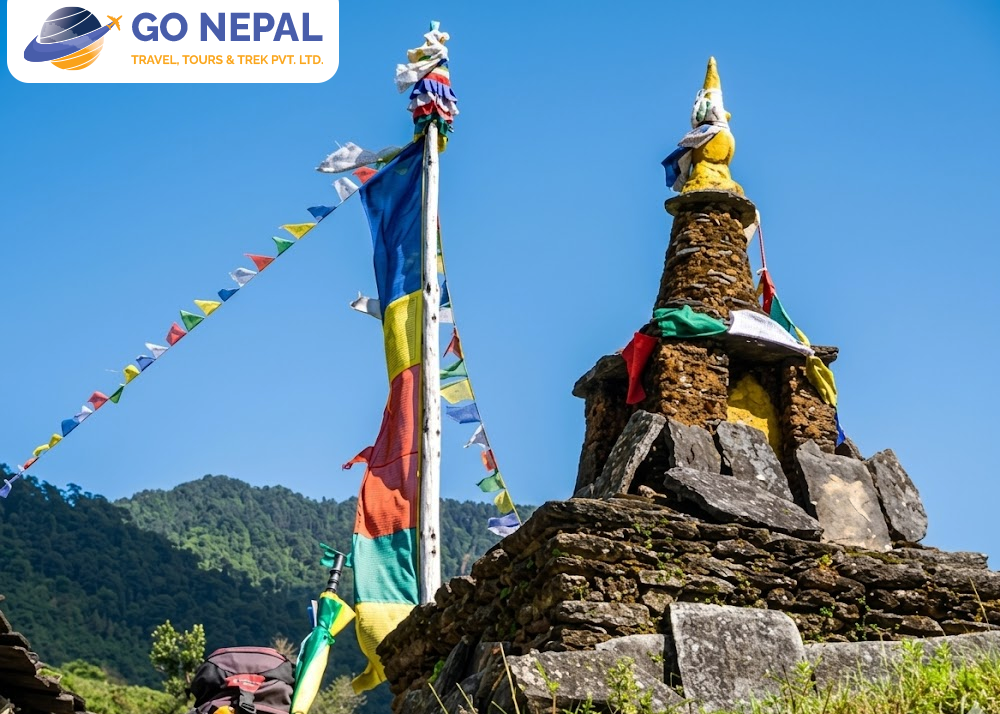
The village is small, consisting of traditional stone houses with prayer flags fluttering from every roof. There are no hotels here only basic lodges and the hospitality of the local families who have lived here for generations. The center of life is the Chöra Gephel Ling Monastery, a site of immense spiritual importance where monks still practice the ancient traditions of the Drikung Kagyu lineage.
Key Highlights of the Trek
· Dudul Phuk (Cave of Conquest): This is the most famous cave where Milarepa meditated. It is said he performed miracles here to subdue local demons. Standing inside the damp, quiet cave, you can almost feel the centuries of meditation that have taken place within its walls.
· The Milarepa Footprints: Scattered around the valley are rocks that locals believe bear the footprints of the Great Yogi.
· The Sacred Water Spouts: Natural springs that are said to have appeared when Milarepa struck the rock with his staff.
· Ama Bamare (The Mother Mountain): An unclimbed, holy peak that dominates the skyline of the valley.
What the Lapchi Nepal Trek Actually Looks Like
· Days 1-3: The Approach
From Shigati, you climb through rhododendron forests (stunning in April/May), cross suspension bridges over the Khimti Khola, and sleep in basic tea houses in villages like Singati and Gongar. These are farming communities. People dry millet on tarps. Chickens scatter when you walk by. Don’t expect trekking luxuries one village had a single shop selling stale biscuits and fake Coke.
· Days 4-5: The Grind
After Gongar, the trail tilts up. Serious up. You’re gaining over 800 meters some days. The forest thins into scrub juniper. You’ll pass yak herders who’ve never seen a foreigner. They’ll stare. You’ll smile. Nobody speaks a common language, but they’ll offer salty butter tea anyway. Drink it. It’s terrible but necessary.
· Day 6: Lower Lapchi (Chyocharmo)
You’ve made it. Altitude: around 3,800 meters (but it feels higher). Lower Lapchi is a scattering of stone huts, a gompa, and that small cave. There’s no lodge. You sleep on a gompa floor or in a herder’s shelter. I slept in a room with a dirt floor and a single yak-skin mat. At night, the wind sounds like someone moaning. I didn’t sleep well. But I woke to the sun hitting the Tibetan peaks across the border, and that made up for everything.
· Days 7-11: The Return
You go back the same way. There’s no loop. Some trekkers hate this. I didn’t. Because descending, you notice things you missed: a mani stone carved with a mantra, a side valley that leads to a frozen lake, the way the light changes on the cliffs. On the last night, I stayed in a tea house with a family who fed me dal bhat and asked about my parents. Normal human stuff. After days of silence, it felt like coming home.
The Reality of the Trail: What to Expect in 2026
This is not a luxury trek. If you are looking for hot showers, espresso machines, and high-speed internet, Lapchi will be a shock. However, if you are looking for an authentic connection to the land, this is it.
|
Category |
What to Expect |
|
Physical Demand |
High. Expect 6–8 hours of walking daily on steep, uneven terrain. |
|
Communication |
Zero. Cell service drops off shortly after Lamabagar. |
|
Food |
Local and organic. Dal Bhat, Tsampa (barley flour), and Yak butter tea. |
|
Wildlife |
High chance of seeing Himalayan Tahrs, Musk Deer, and various bird species. |
When to Go (And When to Absolutely Not Go)
Best time: Mid-September to November (post-monsoon, clear skies, crisp air). Also April to early May (rhododendrons in bloom, stable weather).
Avoid: June to August (monsoon = leeches, landslides, and leeches on top of leeches). December to February (extreme cold, passes closed, night temps drop to -15°C).
What to Pack
You know the usual trekking gear. Here’s the Lapchi-specific list:
· A good sleeping bag (comfort rating -10°C). Gompa floors are cold concrete.
· Water purification tablets. No lodges with boiled water. Streams are clean-ish but giardia is real.
· Toilet paper and a towel. Bury it. Pack it out if you can.
· Earplugs. Yak bells at 2am. Dogs fighting. Wind howling. Trust me.
· Cash. Lots of small notes. No ATMs. No card machines. You pay for everything food, tea, “accommodation” (that dirt floor room) in rupees.
· Tibetan prayer scarf (khata). Bring one from Boudhanath in Kathmandu. Offer it at Milarepa’s cave. It’s a small gesture, but the nun there lit up when I did it.
Permits and Logistics
Since Lapchi is a border region, you will need:
· Gaurishankar Conservation Area Project (GCAP) Permit.
· TIMS (Trekkers' Information Management Systems) Card.
It is highly recommended to trek with a licensed guide who understands the local customs and the specific spiritual history of the caves.
Why Lapchi Stays "Hidden"
You might wonder why such a beautiful place isn't as famous as the Annapurna Sanctuary. The answer lies in its protection. The local community and the monastic order have worked hard to keep Lapchi as a place of retreat rather than a place of mass tourism.
There is a "vibe" in Lapchi that demands respect. It’s a place where you lower your voice. It’s a place where you watch the eagles soar and realize that the world is much bigger than your daily worries.
Final Thoughts: A Call to the Mountains
The Lapchi Nepal Trek is a journey for the soul. It challenges your body with its steep climbs and rewards your mind with its profound stillness. In a world that is increasingly loud and frantic, Lapchi remains a "Hidden Paradise" a sanctuary where you can follow in the footsteps of Milarepa and find your own sense of peace.
If you are ready to trade your phone for a prayer wheel and your spreadsheets for a view of the unclimbed Himalayas, Lapchi is calling. It is a reminder that the best things in life aren't found on a screen, but at the end of a long, dusty trail.


